Hiring Insured Junk Removal: A Complete Guide
Table of Contents
- Why Hiring Insured Junk Removal Services Matters
- Understanding Junk Removal Liability Insurance
- Questions to Ask Junk Removal Companies Before Booking
- Getting Junk Removal Estimates and Pricing
- Junk Removal Preparation Checklist
- Verifying Insurance Coverage and Credentials
- What Happens If Your Property Is Damaged
- Conclusion
- Frequently Asked Questions
Last Updated: October 11, 2026
Why Hiring Insured Junk Removal Services Matters
When you hire a junk removal company, you’re inviting strangers into your home or business to handle your belongings and navigate your property. Without proper insurance, you’d be stuck covering costs if a crew member damages your walls, floors, or furniture, or if a truck hits your fence.
This is where hiring insured junk removal services becomes non-negotiable. A fully insured company has liability coverage that protects you if property damage occurs during the job.
The difference between an insured and uninsured operator is the difference between having recourse if something goes wrong and absorbing the loss yourself.
Understanding Junk Removal Liability Insurance
Liability insurance covers property damage and bodily injury during service, from dents in door frames to injuries from debris.
Commercial general liability (CGL) insurance is the baseline coverage any professional company should carry, typically covering bodily injury and property damage up to $1 million per occurrence.
Workers’ compensation insurance covers employees injured on the job, keeping costs with the company rather than potentially exposing you to liability.
Commercial auto liability covers truck-related damage to your property, car, or mailbox.
Questions to Ask Junk Removal Companies Before Booking
“Can you provide proof of liability insurance?” Ask them to email a certificate of insurance showing company name, coverage limits, and policy dates. If they hesitate or say they’ll bring it the day of, that’s a red flag.
“What are your coverage limits?” Standard is $1 million per occurrence; smaller operators may carry $300,000-$500,000.
“Are your crew members employees or independent contractors?” This determines who carries workers’ compensation and where liability sits if someone is injured.
“What’s your process if something gets damaged?” A professional company documents damage, reports it to insurance, and works toward resolution. Vague answers are a red flag.
“Do you have licensing and bonding?” Bonding is a sign of accountability, a financial guarantee they’ll follow through on obligations.
“How long have you been in business?”
Getting Junk Removal Estimates and Pricing
Pricing varies by volume, item type, and accessibility. Electronics and appliances incur additional fees due to regulated disposal.
Most companies offer free estimates. In-person estimates are more accurate because crews can identify obstacles and measure access points.
How to Request and Compare Estimates
Provide the same level of detail to each company to ensure apples-to-apples comparisons.
Ask for a written estimate that breaks down base labor, volume charges, special-item fees, fuel surcharges, recycling/donation fees, minimum charge, and cleanup costs.
If a company gives a single number with no breakdown, ask them to itemize it. Vague estimates signal potential hidden charges.
Spotting Hidden Fees and Red Flags
Compare estimates and ask why they differ. Crew size, disposal method, insurance overhead, and accessibility all affect pricing. A fully insured, licensed company will cost more than an uninsured operator, this is the price of protection, not a hidden fee.
Watch for estimates that seem too low. Extremely cheap pricing often means the company cuts corners on insurance, proper disposal, or crew quality.
Comparing Quotes: The Checklist
Once you have two or three estimates, create a simple comparison:
| Item | Company A | Company B | Company C |
|---|---|---|---|
| Base labor | $400 | $500 | $350 |
| Special-item fees | $150 (appliances) | $0 (included) | $200 (appliances + electronics) |
| Fuel/travel | $0 | $75 | $0 |
| Minimum charge | $300 | $400 | $250 |
| Total estimate | $550 | $575 | $550 |
| Insured? | Yes | Yes | No |
| Licensed? | Yes | Yes | No |
In this example, Company A and C have the same price, but Company A is insured and licensed while Company C is not. Company C is the riskier choice despite matching the price.
Before booking, clarify how overages are charged, whether scope changes are allowed, if basement/attic items cost extra, deposit and cancellation policies, and payment timing.
Get two or three estimates to gauge market rates. Prioritize companies with proven liability insurance; uninsured companies are cheaper but leave you liable for damage.
Junk Removal Preparation Checklist
Before the appointment: Clear pathways, move valuables, flag hazardous items, take photos of the space, and confirm 24 hours ahead. On the day of service: Be present, point out areas of concern, and walk the crew through what’s being removed. This prevents most accidents and misunderstandings.
Verifying Insurance Coverage and Credentials
Verifying a certificate is legitimate and current is critical. Many customers accept certificates at face value, only to discover later the policy expired or limits were too low.
How to Request a Certificate of Insurance
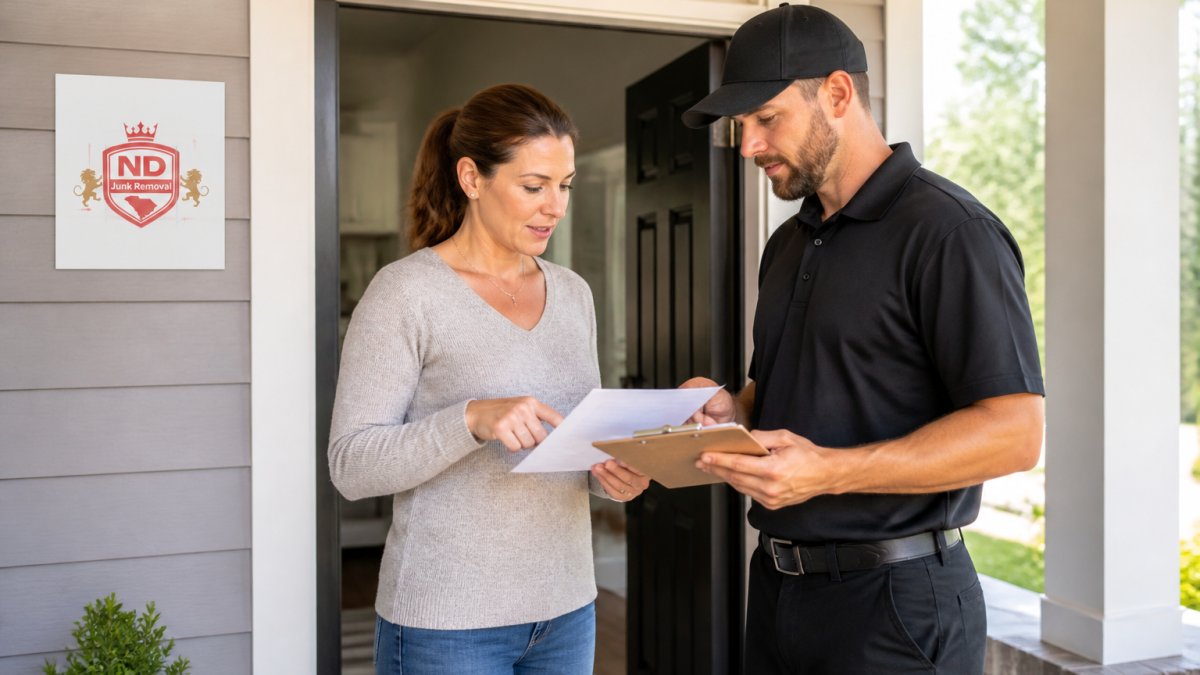
Request a current certificate of insurance showing general liability, workers’ compensation, and commercial auto liability with policy numbers and agent contact info. A legitimate company emails this within 24 hours. If they say they’ll bring it the day of service, that’s a red flag.
Call Now & Save $20 OFF Your Pickup! →
The certificate should be on official letterhead from the insurance company and include the company’s legal name, insurance company contact info, policy numbers, coverage limits, effective and expiration dates.
What to Check on the Certificate
Once you have the certificate, verify these details:
1. The company name matches exactly. The certificate should list the exact legal business name you hired. Mismatches signal a problem.
2. The policy dates are current. Confirm the policy won’t expire before your appointment. Ask when it renews and request a renewal certificate if renewal is coming soon.
3. The coverage limits are adequate. Standard is $1 million per occurrence. For major jobs, ask for higher limits or to be named as an additional insured.
4. The insurer is legitimate. The certificate lists the insurance company’s name. You can verify it’s real by:
- Calling the phone number on the certificate and asking to confirm the policy
- Visiting the insurance company’s website and searching for the junk removal company by name
- Checking the National Association of Insurance Commissioners (NAIC) database at NAIC Insurance Company Search to confirm the insurer is licensed in your state
Don’t rely on the junk removal company’s word alone. Call the insurer directly. Say: “I’m about to hire [Company Name] for junk removal. Can you confirm they have an active general liability policy with you?” A legitimate insurer will confirm this (they may not disclose specific limits due to privacy, but they’ll confirm the policy exists).
5. Coverage types are appropriate. The certificate should show general liability, workers’ compensation (if employees), and commercial auto liability. If commercial auto is missing, ask why. Personal auto policies typically exclude commercial use.
6. Request to be named as an additional insured (for larger jobs). For jobs over $2,000 or for commercial properties, ask: “Can you add me as an additional insured on your general liability policy?” This gives you direct coverage under their policy if something goes wrong. Not all companies offer this, but it’s worth asking. If they agree, ask for an updated certificate showing you as an additional insured.
Verifying Licensing and Bonding
Licensing requirements vary by state and locality. Some states require junk removal companies to be licensed as waste haulers or contractors; others don’t. Check your state’s requirements:
- Visit your state’s Department of Environmental Quality, Department of Waste Management, or equivalent agency website
- Search for “junk removal license” or “waste hauler license” for your state
- Ask the company: “Are you licensed in [your state]? What’s your license number?”
- If they claim to be licensed, verify the number on the state website
Bonding is a financial guarantee. A bonded company has posted a bond (typically $5,000-$25,000) with a bonding company. If the junk removal company fails to complete the job or violates their contract, you can file a claim against the bond. Bonding is not required in most places, but it’s a sign of accountability. Ask: “Are you bonded?
Red Flags: When to Walk Away
If any of these apply, do not hire the company:
- They refuse to provide a certificate of insurance or become defensive when asked
- The certificate is dated more than 60 days ago and they can’t provide a current one
- The certificate shows coverage limits below $500,000 for a significant job and they won’t increase it or add you as additional insured
- The insurance company name on the certificate doesn’t match when you call to verify
- They claim to be licensed but can’t provide a license number or the number doesn’t check out
- They offer a verbal “yes, we’re insured” without documentation
- The certificate lists a different company name than the one you’re hiring
What to Do With the Certificate
Once you’ve verified the certificate, keep a copy for your records. Store it with your contract and any photos or estimates. If damage occurs during the job, you’ll need this certificate to file a claim. You may also need it for your own insurance company if you file a claim on your homeowner’s or business policy.
Ask the company for references from recent jobs, specifically customers who had property damage during service and how it was resolved. If they can’t provide any references, or if customers report problems with damage claims, that’s a signal to look elsewhere.
What Happens If Your Property Is Damaged
Despite precautions, accidents happen. A crew member backs the truck into your mailbox. A ladder scratches your door frame. A heavy item gets dropped on your hardwood floor.
If the company is insured, here’s the process:
Report it immediately. Don’t wait days or weeks. Tell the crew member on the spot, or call the company’s office the same day. Document the damage with photos from multiple angles.
Get the claim number. The company should file a claim with their insurance. Ask for the claim number and the insurance company’s contact information. Write it down.
Follow up in writing. Send an email summarizing the incident, date, time, what happened, photos attached. This creates a paper trail.
Get repair estimates. Get quotes from contractors to fix the damage. Send these to the insurance company. They’ll either approve the repair or offer a settlement.
Don’t sign anything that limits your rights. Some companies ask you to sign a waiver absolving them of liability. Don’t do it. Your right to file a claim is separate from the company’s right to work on your property.
If the company is uninsured, you have fewer options. You can sue them in small claims court (if the damage is under the court’s limit) or hire a lawyer for larger claims. But collecting money from an uninsured operator is difficult. This is why hiring insured junk removal services matters so much.
If a company refuses to provide proof of insurance or becomes defensive when you ask about coverage, walk away. This is the clearest sign they’re not properly insured. No legitimate business hides this information.
Conclusion
Hiring insured junk removal services isn’t just about removing clutter, it’s about protecting your property and your wallet. When you choose a fully licensed and insured operator like ND Junk Removals, you get a team that carries comprehensive liability coverage, maintains current credentials, and stands behind their work. We handle everything from efficient loading to thorough cleanouts with transparent, upfront pricing and no hidden fees. Call now to schedule your service and experience the stress-free difference that proper insurance and professional accountability make.
Frequently Asked Questions
How do I verify that a junk removal company is insured?
Ask the company to provide proof of current liability insurance before scheduling service. Request their certificate of insurance (COI) and verify the policy is active by contacting their insurance provider directly. Check that the coverage amount is adequate for your property and the scope of work. Licensed junk removal companies are required to carry this coverage, so any hesitation to provide documentation is a red flag.
What insurance should a junk removal company have?
Professional junk removal companies should carry general liability insurance to cover property damage and bodily injury. Many also carry workers’ compensation insurance to protect their crew. The liability coverage limit should be at least $1 million for residential work. Ask whether they carry pollution liability if they handle hazardous materials like old appliances or electronics.
What questions should I ask before hiring a junk removal service?
Ask about their licensing, insurance, and bonding status. Clarify what items they can remove (electronics, appliances, hazardous materials). Confirm their pricing structure and whether there are additional fees for stairs, long carries, or heavy items. Ask how they handle recycling and donations. Request their service timeline and whether they offer same-day or next-day scheduling. Finally, ask for references from recent jobs similar to yours.
Does homeowners insurance cover damage caused by junk removal?
Most homeowners insurance policies do not cover damage caused by a service provider’s negligence. This is why hiring an insured junk removal company is critical, their liability insurance covers damage to your property during the removal process. If damage occurs, file a claim with the junk removal company’s insurance, not your own. Your homeowners policy may cover damage only if the company’s insurance doesn’t respond or if the damage exceeds their coverage limit.