Construction Debris Removal Services: A Complete Guide
Table of Contents
- What Is Construction Debris Removal and Why It Matters
- Types of Construction and Demolition Waste You’ll Encounter
- How to Handle Tile Disposal Safely
- Cost of Construction Debris Removal: What Affects Your Price
- Dumpster Rental vs Full-Service Junk Removal: Which Fits Your Project
- How the Removal Process Works From Start to Finish
- Eco-Friendly Disposal and Recycling Options
- Permitting and Local Regulations You Need to Know
- Frequently Asked Questions
Last Updated: October 4, 2026
What Is Construction Debris Removal and Why It Matters
Construction debris removal is the professional hauling and disposal of waste materials generated during renovation, demolition, or new construction projects. Unlike regular trash pickup, it includes bulky, heavy items like drywall, concrete, lumber, tile, and metal that require specialized equipment and handling.
Construction sites generate massive volumes of waste quickly. Without a proper removal plan, debris accumulates, creates safety hazards, delays timelines, and complicates property access. ND Junk Removals handles the entire process so you can focus on your project.
Improper disposal leads to code violations, fines, and environmental concerns. Professional construction debris removal services ensure materials are handled safely, sorted for recycling, and disposed of responsibly.
Types of Construction and Demolition Waste You’ll Encounter
Construction and demolition waste falls into distinct categories, each requiring different handling and disposal methods.
Inert debris includes concrete, brick, tile, stone, and asphalt, heavy, stable materials often recyclable into aggregate for road base or new concrete.
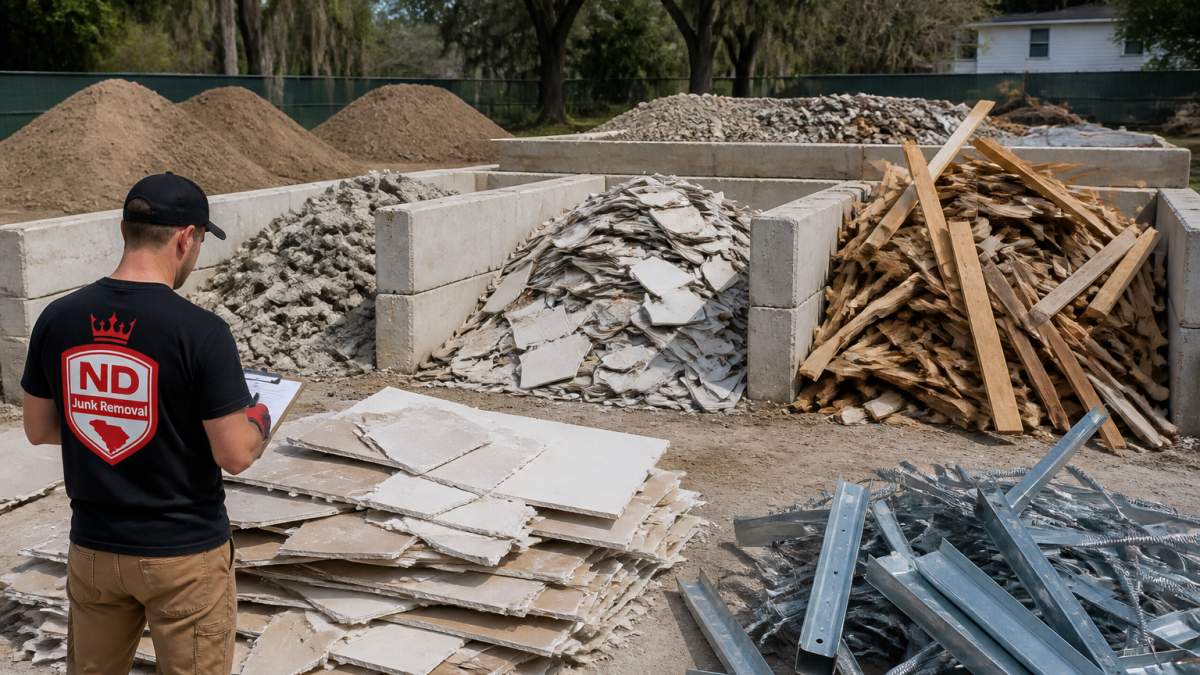
Wood and lumber include framing, flooring, and trim. Clean, untreated wood can be recycled; pressure-treated or painted wood requires careful disposal to avoid contamination.
Drywall and gypsum require separation from other materials to prevent contamination of recycling streams.
Metals, copper, aluminum, steel, and iron, have significant scrap value. Separating metals during removal increases recycling rates and can offset some hauling costs.
Mixed debris combines multiple material types and presents the biggest disposal challenge, requiring time and labor to sort, why professional services simplify this process.
Hazardous materials like asbestos, lead paint, and certain insulation require specialized handling and licensed disposal. Many renovation projects in older buildings encounter these materials unexpectedly, making professional assessment critical.
How to Handle Tile Disposal Safely
Tile disposal presents unique challenges: broken tile creates sharp edges, dust may harbor hazardous materials in older buildings, and it requires careful separation from other debris.
Broken ceramic or porcelain tile has razor-sharp edges that cut through gloves and skin. Dust from tile removal in pre-1980s buildings may contain asbestos or lead. Proper handling protects workers and prevents environmental contamination.
For small tile projects, place broken tile in a heavy-duty bag with a lid, wear heavy gloves and a dust mask, and keep it separate from other debris.
For larger tile removal, wet-cutting methods with diamond-blade saws reduce dust and produce cleaner tile that may be recyclable.
Asbestos testing is essential for tile in buildings constructed before 1980. Tile and adhesive may contain asbestos. Professional abatement contractors can test and safely remove these materials, never attempt removal without testing.
Recycling tile is possible but limited. Some facilities accept clean, broken tile for aggregate; contaminated tile goes to landfill. Separate tile from other debris to maximize recycling potential.
ND Junk Removals handles tile disposal as part of comprehensive construction debris removal.
Cost of Construction Debris Removal: What Affects Your Price
Volume is the primary cost driver. Hauling services charge by cubic yardage. Larger volumes require multiple trips, increasing costs proportionally.
Material composition matters. Inert materials cost less to dispose of than mixed debris. Hazardous materials demand specialized handling, adding significant cost.
Labor intensity affects pricing. Sorted, accessible debris is faster and cheaper to remove. Debris buried in walls or difficult to access requires more labor.
Distance to disposal facilities influences costs. Projects far from recycling centers or landfills pay higher transportation fees.
Local regulations and tipping fees vary by jurisdiction. Understanding local requirements prevents surprise costs.
Timing and scheduling flexibility can reduce costs. Rush jobs carry premiums; standard business hours cost less than evening or weekend service.
Request a free estimate from a professional service for accurate pricing. ND Junk Removals provides upfront pricing with no hidden fees.
Dumpster Rental vs Full-Service Junk Removal: Which Fits Your Project
Choosing between dumpster rental and full-service junk removal depends on your project timeline, debris volume, labor availability, and cost tolerance.
Estimating Your Debris Volume
Before deciding, estimate how much debris your project will generate. Volume is measured in cubic yards (a cube 3 feet × 3 feet × 3 feet). Most debris removal quotes are based on cubic yardage.
Quick Volume Estimation Guide:
- Small bathroom remodel (tile, fixtures, drywall): 2-3 cubic yards
- Kitchen remodel (cabinets, countertops, flooring, drywall): 4-6 cubic yards
- Single-room demolition (walls, flooring, fixtures): 8-12 cubic yards
- Whole-house interior demolition: 30-50+ cubic yards
- Roof tear-off (asphalt shingles, underlayment, wood): 5-8 cubic yards per 1,000 sq ft
- Deck removal (wood framing, fasteners): 3-5 cubic yards per 200 sq ft
To estimate volume: Measure length, width, and height in feet, multiply them, then divide by 27. Example: 10 ft × 8 ft × 4 ft = 320 cubic feet ÷ 27 = 12 cubic yards.
Most professional removal services offer free estimates that eliminate guesswork.
Dumpster Rentals: Best for Predictable, Large-Volume Projects
Dumpster rentals provide a container for 1-2 weeks. You load debris yourself; the company hauls it away when full. This works well for projects where you control the timeline and have labor available.
Dumpster advantages:
- Lower per-unit cost for volumes exceeding 10 cubic yards
- Flexible loading schedule
- Predictable pricing
Dumpster drawbacks:
- Requires physical labor to load heavy materials
- Takes up driveway or property space for 1-2 weeks
- You manage sorting and organization
- Potential liability if debris spills or violates local regulations
- Extra charges for hazardous materials or oversized items
- Overage fees if weight limits are exceeded
Cost example: A 20-cubic-yard dumpster rents for $300-$500 per week, or $15-$25 per cubic yard, economical for large volumes.
Full-Service Junk Removal: Best for Small to Medium Projects and Convenience
Full-service junk removal means professionals arrive, assess debris, load everything, and haul it away, often same-day or next-day.
Full-service advantages:
- No physical labor required
- Faster completion (often same-day or next-day)
- Professional handling of hazardous materials
- Debris sorted and recycled responsibly
- Minimal property disruption
- Liability protection
- Transparent pricing with no surprise fees
Full-service drawbacks:
- Higher per-unit cost for very large volumes (typically $30-$50+ per cubic yard)
- Less scheduling flexibility
- Not ideal if debris accumulates over many weeks
Cost example: For 8 cubic yards of mixed debris, full-service removal costs $240-$400 total ($30-$50 per cubic yard), higher per-unit cost than a dumpster, but no labor required and often same-day service.
Decision Framework: Which Service Makes Sense?
Call Now & Save $20 OFF Your Pickup! →
Choose a dumpster rental if:
- Your project generates 15+ cubic yards of debris
- You have 2+ weeks to complete loading
- You have able-bodied labor available (friends, crew, or workers)
- Debris will accumulate gradually (not all at once)
- Your property has space for a large container
- Your budget is tight and per-unit cost matters more than convenience
Choose full-service removal if:
- Your project generates fewer than 15 cubic yards
- You need debris removed within 1-2 days
- You lack labor or prefer not to do physical loading
- Your project involves hazardous materials requiring professional assessment
- Your property lacks space for a dumpster
- You want liability protection and transparent, all-inclusive pricing
- You value recycling and want professional sorting for maximum diversion from landfills
For construction debris, full-service removal often makes more sense. Construction debris is heavy, bulky, and frequently contains hazardous materials requiring professional assessment.
Professional services offer free volume estimates and often provide both options, so you can choose the best fit for your needs.
How the Removal Process Works From Start to Finish
Step 1: Assessment and Estimate
A representative visits your property, evaluates debris volume and composition, identifies hazardous materials, and provides a free written estimate.
Step 2: Scheduling
You choose a convenient removal date.
Step 3: Debris Inspection
The crew does a final walk-through to confirm debris location.
Step 4: Loading
Professionals load debris using appropriate equipment. Heavy items like concrete and metal are loaded first; lighter materials follow.
Step 5: Sorting and Segregation
Materials are sorted for recycling, donation, or landfill disposal to maximize diversion from landfills.
Step 6: Cleanup
The crew sweeps and cleans the work area. Your property is left clean and ready.
Step 7: Disposal and Documentation
Debris is transported to appropriate facilities.
ND Junk Removals manages every step, so you never have to wonder where your debris went or whether it was handled responsibly.
Eco-Friendly Disposal and Recycling Options
Recycling inert materials is most impactful. Concrete, brick, tile, and stone are crushed and reused as aggregate in new concrete, road base, or landscaping material, keeping massive volumes out of landfills.
Wood recycling diverts lumber from landfills. Clean, untreated wood is chipped for mulch or animal bedding.
Metal recovery captures copper, aluminum, and steel for reprocessing. Metals are infinitely recyclable without quality degradation.
Drywall recycling is growing. Recycled drywall is used in cement production and agricultural applications. Separating drywall from mixed debris enables this recovery.
Donation programs extend the life of reusable materials. Architectural salvage companies and building material reuse centers accept fixtures, trim, doors, windows, and hardware for resale.
Hazardous material handling prevents environmental contamination. Asbestos, lead paint, and other hazardous materials are disposed of at licensed facilities.
ND Junk Removals prioritizes recycling and donation, diverting the majority of construction debris from landfills.
Permitting and Local Regulations You Need to Know
Construction debris removal is subject to local regulations that vary by jurisdiction. Understanding these requirements prevents fines, project delays, and liability issues.
Building Permits and Debris Management Plans
Most renovation or demolition projects require a building permit. The permit application typically includes a debris management section. The building inspector may require proof that debris will be disposed of at a licensed facility.
Dumpster Placement and Street Use Permits
Many jurisdictions require permits for dumpsters placed in rights-of-way, on sidewalks, or in parking areas. Some areas limit how long a dumpster can remain (typically 7-14 days). Violations result in fines of $100-$500 per day.
Hazardous Material Disclosure and Licensed Contractor Requirements
If your project involves a building constructed before 1980, assume asbestos and lead paint are present. Many jurisdictions require notification before disturbing these materials.
Waste Diversion and Recycling Mandates
Some jurisdictions require that a minimum percentage of debris (often 50-75%) be diverted from landfills through recycling or donation.
Disposal Facility Restrictions and Tipping Fees
Not all debris can go to the same facility. Inert materials go to specialized facilities; mixed debris goes to municipal landfills; hazardous materials go to licensed facilities.
Weight and Vehicle Restrictions
Trucks are subject to weight limits enforced by the Department of Transportation. Residential areas may restrict truck size or access hours. Professional removal services use appropriately sized equipment and schedule work during permitted hours, ensuring compliance.
Documentation and Proof of Proper Disposal
Keep records of all debris removal and disposal. Professional removal services provide detailed invoices and disposal documentation showing where each material category went.
Professional construction debris removal services stay current with local codes and maintain compliance documentation, ensuring your project proceeds without delays or fines.
Frequently Asked Questions
How much does construction debris removal typically cost?
Pricing for construction debris removal depends on the volume of waste, type of materials, distance to disposal facilities, and whether you need same-day service. Labor-included hauling costs more than dumpster rental alone, but saves you the physical work. Visit ND Junk Removals’ pricing page for a free estimate tailored to your specific project size and materials.
What’s the safest way to dispose of old tile and ceramic materials?
Tile and ceramic debris contain sharp edges that pose cutting hazards during handling and transport. Professionals wear protective gloves and use specialized containers to prevent breakage. Bagging sharp pieces separately and labeling them clearly helps waste handlers stay safe. Professional removal services handle this hazard management for you.
Can you remove electronics and appliances along with regular construction debris?
Yes, professional removal services handle mixed debris including old appliances and electronics. These items require special handling due to hazardous materials like refrigerants and mercury. Always disclose what you’re throwing away upfront so the team brings appropriate equipment and knows how to dispose of each item responsibly.
How quickly can I get scheduled for debris removal?
Same-day pickup availability depends on current demand and your location. If you have a tight timeline, such as preparing a rental unit between tenants, contact your service provider immediately with your preferred dates. Scheduling flexibility and prompt service are key advantages of full-service removal over managing a dumpster yourself.
Construction debris management doesn’t have to be stressful. Between hazardous material identification, volume estimation, local regulations, and eco-friendly disposal, the logistics are complex. ND Junk Removals handles every detail with our fully licensed and insured team, transparent upfront pricing, and commitment to responsible recycling and donation. We manage the heavy lifting so you can focus on your project. Call now and save $20 off your pickup.